
Training report · Sim Coaches
Why a more accurate Blip candidate stayed in the lab
An H100-trained candidate reached 85.56% phase match. Its estimate of time lost on three diagnostic tracks kept it out of the release.
From the GPU to the PC
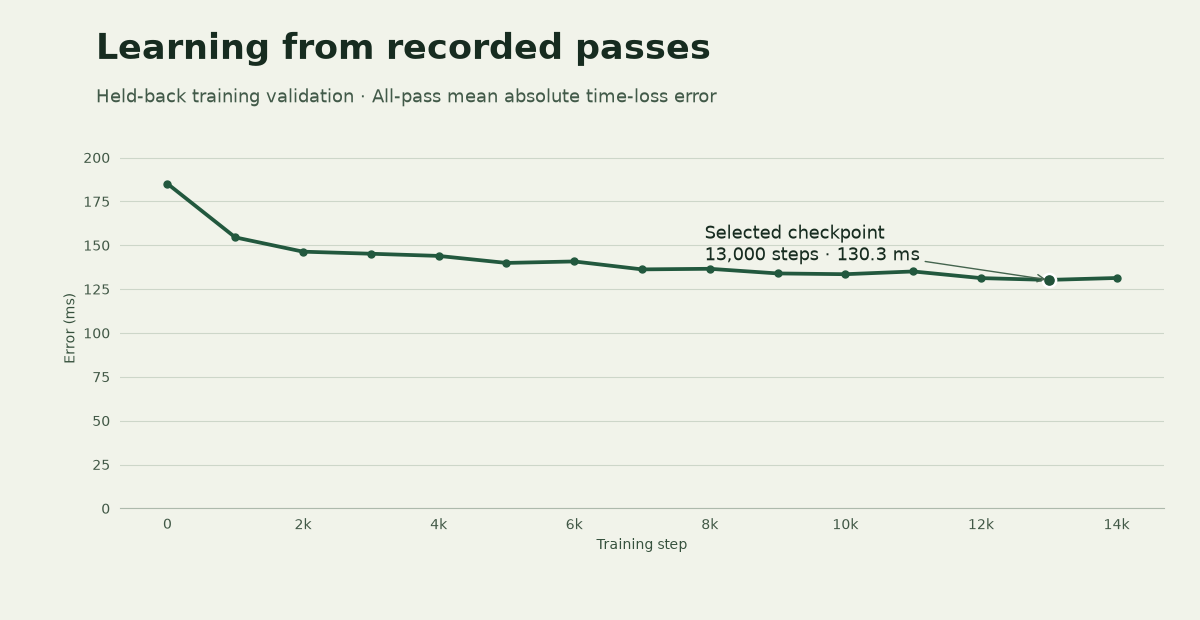
We fine-tuned the model on an NVIDIA H100 using 132,351 corner passes from 114 drivers. Training validation used 3,721 passes from 14 different drivers. The run took 14,041 steps. We selected step 13,000 on validation before opening the separate product exam.
Why the release stopped
Across all five exam drivers, mean absolute time-loss error fell from 0.1638 to 0.1368 seconds. When we looked at the three-track subset, the candidate missed by 0.6837 seconds on average. A constant prediction missed by 0.6015 seconds. The candidate failed that release criterion.
What the test changed
The track result points to a specific research problem. Blip can identify where a driver lost time and still overestimate or underestimate how much it cost. The result calls for better calibration and more independent drivers in future evaluations.
Progress during training
The GPU fit used 132,351 passes from 114 drivers. Another 14 drivers supplied the 3,721 validation passes used to choose the checkpoint. The validation measurements below compare the unchanged starting model with the selected checkpoint at step 13,000. Each percentage describes the reduction in average time-loss error on that validation measure.
| Averaging method | Starting model | Selected step | Error reduction |
|---|---|---|---|
| All passes | 0.18509 | 0.13026 | 29.62% |
| By driver | 0.12538 | 0.10634 | 15.19% |
| By car | 0.14244 | 0.12385 | 13.05% |
| By track | 0.17850 | 0.15158 | 15.08% |
The first row gives each pass equal weight. The remaining rows average within each driver, car or track and then give each group equal weight. The frozen product exam below determined the release decision.
How we scored it
Phase match is the share of passes with more than 0.10 seconds of reference loss where the model identifies the phase with the largest loss. Time-loss error is the mean absolute difference between predicted and reference total corner loss across all passes in that group. Higher phase match and lower error are better. Phase match uses 4,038 eligible passes overall, 230 on the three diagnostic tracks and 203 in the Skip Barber subset. The time-loss error uses 7,702, 563 and 226 passes, respectively.
Baseline. PC coaching model v2 and a constant prediction from the training set.
| Scope | Passes | Model | Phase match (%) | Time-loss error (s) |
|---|---|---|---|---|
| All iRacing | 7702 | Constant | 39.23 | 0.2477 |
| All iRacing | 7702 | Previous v2 | 82.57 | 0.1638 |
| All iRacing | 7702 | Candidate | 85.56 | 0.1368 |
| Three-track subset | 563 | Constant | 43.48 | 0.6015 |
| Three-track subset | 563 | Previous v2 | 74.78 | 0.7178 |
| Three-track subset | 563 | Candidate | 89.57 | 0.6837 |
| Skip Barber subset | 226 | Constant | 59.11 | 0.4296 |
| Skip Barber subset | 226 | Previous v2 | 67.00 | 0.1960 |
| Skip Barber subset | 226 | Candidate | 80.30 | 0.1118 |
Where the evidence ends
Five drivers produced the 7,702 passes, including repeated laps. The three-track subset contains three drivers and the Skip Barber subset contains one. The exam had been examined in earlier work. We did not compute driver-level confidence intervals or measure changes in drivers’ lap times in this test. Assetto Corsa and ACC had no scored cases.